Defend Your Rights Now - Record Everything and Protect Your Liberty! OGM-Body Cam
OurGunsMatter

Community Safety Initiative

A lawful, structured approach to neighborhood protection and responsible self-defense

Learn Our Approach

Training and Education 2

A lawful patrol is defined by its discipline and training, not just its firepower.

1Legal Training

Every member must undergo regular training from a lawyer on Use-of-Force laws in your state. This includes the nuances of "Stand Your Ground" vs. "Duty to Retreat" laws, brandishing laws, and the legal definition of imminent threat.

2Firearms Proficiency

Require members to possess a valid permit to carry (if required in your state) and demonstrate regular proficiency at a certified training course. This should include shoot/don't shoot scenarios.

3De-escalation Training

This is paramount. Members must be trained by professionals in verbal judo and conflict de-escalation. The primary goal is always to avoid using a firearm.

4First-Aid/CPR/Trauma Care

Every patrol should include at least one member certified in stop-the-bleed and trauma first aid. This is for helping neighbors, not just yourselves.

5Communication Training

Learn proper radio protocol and how to give concise, factual descriptions to 911 dispatchers.

Operational Protocols: The "How-To" 3

Clear, written rules of engagement are non-negotiable.

1Mission Statement

The primary mission is observe and report. You are the eyes and ears for law enforcement, not a replacement for them.

2Rules of Engagement (ROE)

A strict, written document that all members must memorize. It must state:

  • Firearms are for self-defense only, drawn only in the face of an imminent, credible threat of death or grave bodily injury to themselves or others.
  • No pursuing suspects.
  • No initiating confrontations.
  • No conducting "stop and detain" activities (this is illegal impersonation of a law enforcement officer).

3Patrol Protocol

Patrols should be in pairs, always in communication with a central dispatcher (often a member at home with a computer). They should be highly visible (wear reflective vests that say "Neighborhood Safety" or similar, NOT anything that resembles police insignia) to deter crime, not provoke confrontation.

4Communication

Use FRS/GMRS radios or a dedicated phone app. All communications should be recorded and logged.

Community Integration and Transparency 4

To avoid being perceived as a "racist mob" themselves, the group must be integrated into the community.

1Community Outreach

Hold public meetings to introduce the program, its goals, and its strict rules. Get buy-in from neighbors.

2Diversity and Inclusion

Actively recruit members from all backgrounds within the neighborhood. This builds trust and ensures the group is seen as protectors of everyone.

3Open-Book Policy

Be transparent about your activities and protocols with community leaders and local law enforcement.

Specific Threat Response 5

1Against "Shooting"

Your role is to hear the shot, locate the origin, call 911 immediately, and provide accurate information to police. You are not to enter the property or engage the shooter unless you directly witness them about to kill someone. Active shooter response is a specific tactical skill set far beyond the scope of a neighborhood patrol.

2Against "Racist Mobs"

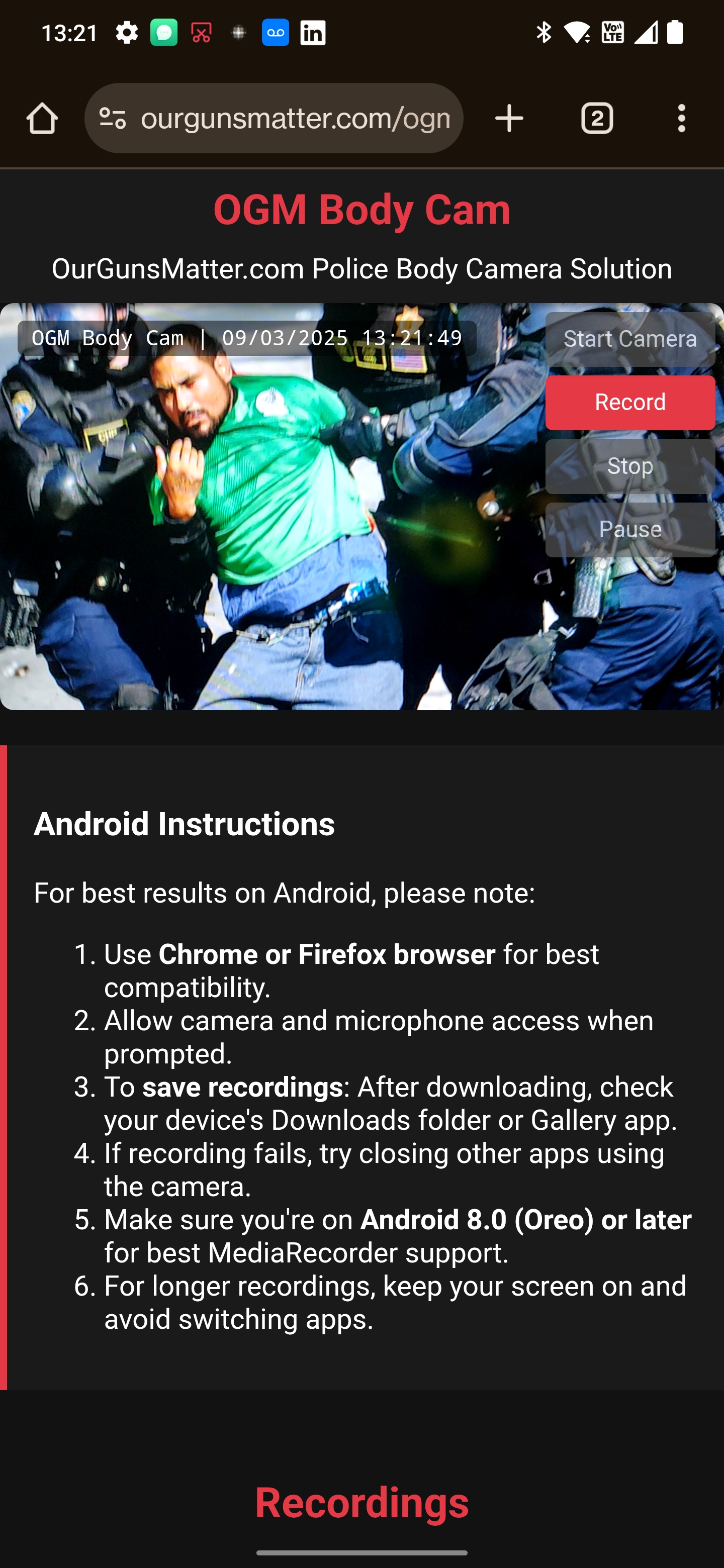
The protocol remains observe and report. Document from a safe distance (take video on our OGM Body Cam if safe to do so), call 911, and provide evidence to law enforcement. Do not engage the mob. Your presence as an organized, armed, and lawful group may deter them from attacking people or property, but the line between defense and provocation is extremely thin and must be managed with extreme caution.

3Against "Law Enforcement Overreach"

This is the most legally complex area. You have no authority to interfere with police or federal agents performing their duties, even if you disagree with them. Your role would be purely documentary: recording events on our OGM Body Cam from a public space (without obstructing justice) to ensure accountability through legal channels later. The best practice here is to have a lawyer on speed dial and to inform residents of their rights, not to physically intervene.

OGM Body Cam

OGM Body Cam

Document incidents safely and legally with our specially designed body camera system. Ensure accountability and protect yourself with indisputable video evidence.

Learn More About OGM Body Cam

HD Recording

Capture clear, high-definition video evidence in any lighting conditions.

Legal Protection

Document encounters to protect yourself from false accusations.

Cloud Backup

Backup all your footage to secure cloud storage to prevent evidence tampering.

Long Battery Life

Record for extended periods with our optimized battery system.

The Lawful Path Forward

The philosophy of "Our Guns Matter" is about responsible, legal self-defense and community protection. A member creating a patrol must embody that responsibility to the highest degree, ensuring all actions are within legal boundaries and focused on community welfare.

The goal is to create a safer environment through preparedness and vigilance, while meticulously staying within the bounds of the law to avoid the very violence and chaos you seek to prevent. Remember: your most powerful weapon is your knowledge of the law, not your firearm.

Implementation Timeline

1

Initial Consultation Phase (Weeks 1-2)

Meet with legal counsel specializing in firearms and nonprofit law. Research local ordinances and state statutes governing community watch programs.

2

Foundation Building (Weeks 3-6)

Establish formal entity, draft bylaws and rules of engagement, and initiate contact with law enforcement liaison.

3

Training Development (Weeks 7-10)

Develop and schedule mandatory training programs for all members, focusing on de-escalation, legal boundaries, and firearms safety.

4

Community Integration (Weeks 11-14)

Hold public meetings, establish transparent communication channels, and begin limited observational patrols.

Recommended Action Plan

Legal Consultation

Retain an attorney specializing in firearms law and nonprofit organizations before any formal activities begin.

Official Recognition

Formally establish a Neighborhood Watch program in partnership with local law enforcement authorities.

Comprehensive Training

Develop mandatory training on de-escalation, state firearms laws, and ethical community protection.

Transparent Operations

Create publicly available guidelines and maintain open communication with all community stakeholders.

Continuous Evaluation

Regularly review and adjust protocols based on legal changes and community feedback.